
AI for allied-health clinics, built inside a working clinic.
Reform Lab is a multidisciplinary clinic in Sydney (chiropractic, physiotherapy and clinical Pilates) that is also an AI startup. We build patient-facing and practice AI for allied-health clinics, and every piece runs with real patients in our own clinic before anyone else uses it.
How it works
Two loops run inside the clinic. One faces patients and never crosses into clinical advice. The other reads de-identified practice data and reports to the care team.
Reform Lab Concierge
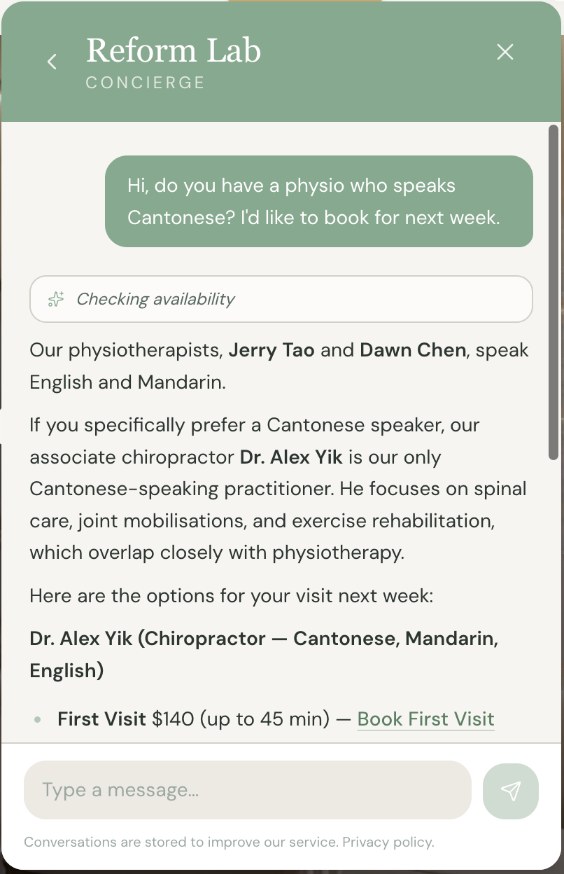
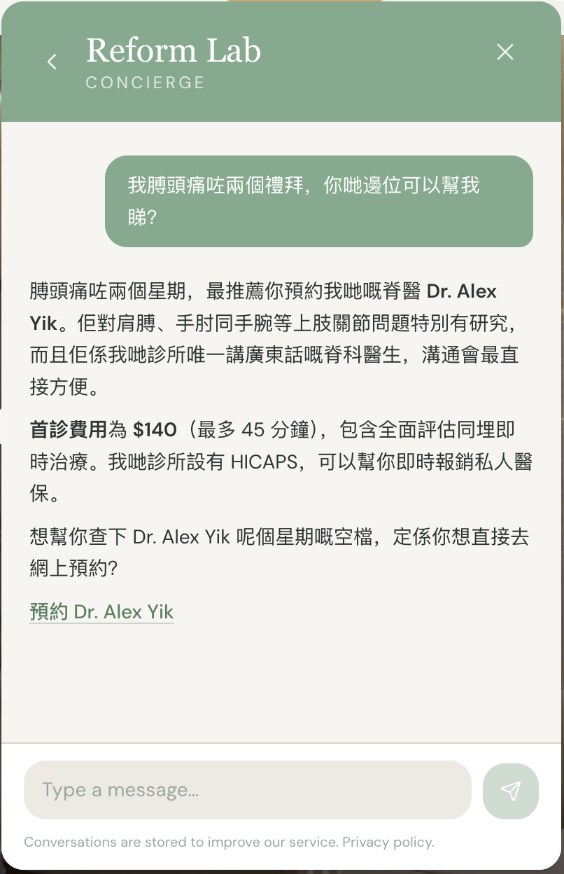
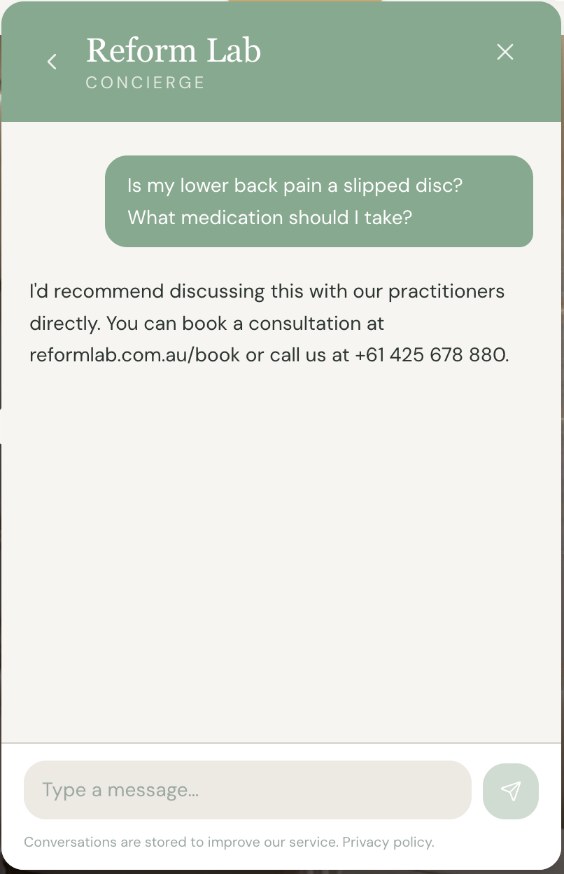
A patient front-desk assistant for allied-health clinics. It answers questions about services, practitioners, prices and availability in English, Mandarin and Cantonese, checks live availability and links straight to booking. A dedicated safety layer stops it from diagnosing or giving medical advice and hands those questions to a practitioner.
Reform Lab Pulse
Patient-journey analytics for the care team. Every week an agent reads the clinic's practice data, reduced to counts and trends before analysis, and writes a short brief the team can act on.
- Today: bookings, new patients, online booking share, practitioner load and the gaps worth fixing, compared with the last four weeks.
- Next: patient-journey signals: rebooking, care-plan completion and lapse risk, so the team can follow up before a patient drops out of care.
- Boundary: appointment-level data only. Clinical notes stay out of the analytics pipeline.
What we are researching
We have recently invested in R&D to move from general cloud models to a small model of our own, tuned for allied-health conversations in three languages and able to run on hardware we control in Australia.
Fine-tuned front-desk model
Fine-tuning a small open-weight model on clinic knowledge and synthetic, clinician-reviewed dialogue, so it handles allied-health questions as well as a large general model at a fraction of the cost.
Safety layer that holds
A hybrid rule-plus-model filter that keeps the assistant out of diagnosis and medical advice in English, Mandarin and Cantonese, including mixed-language messages.
De-identification that keeps signal
Removing patient identifiers from conversations and practice data while keeping enough structure to learn from.
Patient-journey signals
Predicting which patients are likely to lapse from a care plan, from appointment patterns alone, so the care team can reach out early.
Where NVIDIA fits
Our applications run on cloud model APIs today. Patient data is sensitive, so the next step is to train and serve our own models on NVIDIA GPUs in an Australian region.
Cloud model APIs
Concierge and Pulse in daily use at our clinic.
Fine-tune with NeMo
LoRA fine-tuning of a small open-weight model on NVIDIA GPUs, onshore.
Serve with NIM
Run the tuned model in Australia so conversations never leave the country.
Voice front desk
Phone and walk-in support in Cantonese and Mandarin with speech AI.
Data and safety
We are a clinic first. The same duty of care that applies in the treatment room applies to our software.
Never diagnoses
Clinical questions are handed to a registered practitioner.
Stored in Australia
Conversations and practice data are stored onshore.
De-identified first
Identifiers are stripped before anything is analysed or used for training.
People in the loop
The care team reviews every insight before it reaches a patient.
Talk to us
Led by Dr. Ethan Chen, founder and clinic director of Reform Lab. For partnerships, research or technical questions, email Ethan Chen at ethan.chen@reformlab.com.au. For appointments, visit reformlab.com.au.